Artificial Intelligence
What Can 2x Workstations built on NVIDIA DGX Station B300 Do for Agentic AI?
September 28, 2026
10 min read


Agentic AI systems rarely run a single model. A typical pipeline pairs a large reasoning model that plans and delegates with smaller models that retrieve documents, call tools, write code, and check results, and every one of them competes for GPU memory at the same time.
A single Exxact Valence built on NVIDIA DGX Station B300 handles a lot of that from a desk. But what can you do with two?
Each unit is built around the NVIDIA GB300 Grace Blackwell Ultra Desktop Superchip, pairing one Blackwell Ultra GPU with a 72-core Grace CPU over NVLink-C2C. Per NVIDIA's development guide, a single system provides:
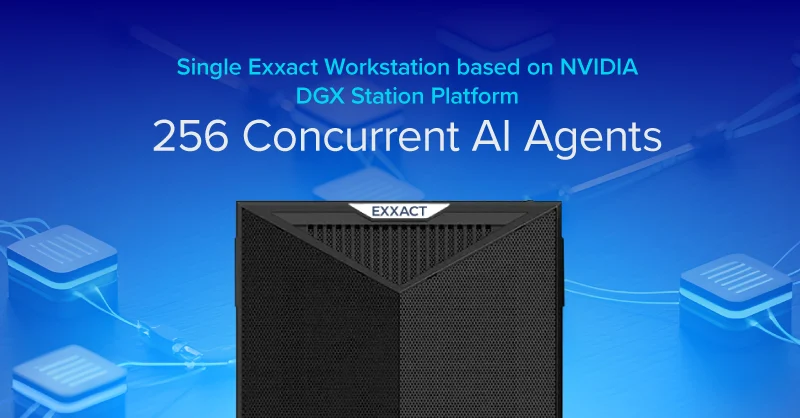
What we measured: One Valence with GB300 ran 256 concurrent Qwen3 agents with zero failed agents and a stable 0.824–0.897 pass-rate range. With DeepSeek V4 Flash, vLLM reported 11.1 million tokens of KV-cache capacity—enough for an estimated 10.6 simultaneous sessions configured for one million tokens each.
Those results reinforce the practical limit: agent count alone is not the bottleneck. Model architecture, context length, and KV-cache demand determine capacity. Weights that spill beyond the 252GB of HBM3e into LPDDR5X also run at much lower bandwidth, so repeated agent calls amplify the slowdown.
Two GB300 Systems link directly with no switch. NVIDIA's two-system playbook calls for two 400G QSFP cables match port 0s and port 1s on each Exxact Valence with GB300. Each cable acts as an independent 400Gb/s rail running RoCEv2 (RDMA over Converged Ethernet) which moves data between systems' memory with minimal CPU involvement.
There is no NVLink between the two systems. NVIDIA estimates 45 to 60 minutes for core fabric bring-up, including jumbo frames (MTU 9000) and a GPUDirect RDMA check before running NCCL, Ray, or vLLM.
A few practical details to plan for:
Two units give you two GPUs, 504GB of HBM3e, 1,496GB of total coherent memory across two separate pools, and up to 40 petaFLOPS of sparse FP4. How you spend that depends on which of four deployment patterns fits your workload.
| Pattern | What runs where | Load on the 800Gb/s link | Redundancy |
|---|---|---|---|
| Split roles | Orchestrator on unit A, tool and execution models on unit B | Light (prompts and responses) | Partial |
| Shard one large model | One model split across both GPUs | Heavy (activations every token) | None |
| High availability | Identical stack mirrored on both | Minimal | Full |
| Parallel long-context sessions | Sessions routed to either unit | Minimal | Full |
Unit A dedicates its 252GB of HBM3e to the orchestrator model and its KV cache—the stored attention state that grows with context. Unit B runs the execution tier, with tool models isolated in separate MIG partitions when appropriate. Plans and results move between the systems as lightweight text traffic.
The two systems provide 504GB of aggregate HBM3e. For example, a 550-billion-parameter model at 4-bit precision requires roughly 275GB for weights alone. NVIDIA's dual-system vLLM workflow targets this type of deployment with the 550B-parameter Nemotron 3 Ultra mixture-of-experts model.
Mirror the complete agent stack on both systems and place a load balancer in front. An active-active configuration distributes normal traffic across both nodes, while active-standby keeps one system ready as a warm spare.
Sessions are routed to either system instead of sharing one GPU. This distributes the growing KV-cache demand created by retrieved documents, tool results, and accumulated context.
| Spec | 1x Exxact Valence with B300 | 2x Exxact Valence with B300 | HGX B300 server |
|---|---|---|---|
| GPUs | 1 Blackwell Ultra | 2 Blackwell Ultra | 8 Blackwell Ultra (B300 SXM) |
| GPU memory (HBM3e) | 252GB | 504GB | 2,304GB |
| Total coherent memory | 748GB | 1,496GB (two pools) | HBM plus host memory, config-dependent |
| Aggregate HBM bandwidth | 7.1TB/s | 14.2TB/s | Up to 64TB/s |
| FP4 AI compute | Up to 20 PFLOPS (sparse) | Up to 40 PFLOPS (sparse) | Up to 144 PFLOPS |
| GPU-to-GPU link | N/A | 2x 400Gb/s RoCEv2 (~100GB/s) | NVLink 5 at 1.8TB/s per GPU |
| Scale-out | Pairs with one peer | Documented maximum | 8x ConnectX-8 at 800Gb/s per GPU, switched fabric |
| Deployment | Deskside, 1,600W PSU | Two deskside units, two circuits | Rack server (8U air or 4U liquid cooled) |
| When to Choose | • Your largest model plus its KV cache fits in 252GB of HBM3e • One team is developing and testing agents with low concurrent users • Occasional downtime is acceptable | • Need more than 252GB of fast memory or more than 748GB total • Need redundancy • Rack space and data center power/cooling not an option • Want a separate but dedicated inference, fine tuning. | • Need tensor-parallel serving of trillion-parameter models at production throughput • Dozens or hundreds of concurrent users • Workload is multi-node fine-tuning and/or training • You expect to grow past two nodes into a switched cluster |
Two linked units extend what a desk can do, but they remain two separate computers joined by Ethernet. The limits show up in four places:
No. Two QSFP cables connect the units directly, one per 400Gb/s rail.
NVIDIA documents clustering two systems and doesn't publish a configuration beyond that. Teams that need more nodes should look at rack-scale HGX infrastructure.
No. They operate as two nodes over RoCEv2, and frameworks such as vLLM with Ray, or NCCL-based training, handle distributing work between them.
NVIDIA rates it for models up to 1 trillion parameters within the 748GB coherent pool. Anything beyond the 252GB of HBM3e runs from slower LPDDR5X, so expect lower tokens per second than a model that fits entirely in GPU memory.
Split roles. It keeps every model in fast local memory, puts almost no load on the link, and still leaves the option to reconfigure for sharding or high availability later.
Two linked units make the most sense when an agent system has outgrown one GPU's fast memory but doesn't justify a rack. Size your orchestrator model and KV cache against 252GB of HBM3e first. If it fits, the second unit is best spent on tool models or redundancy. If it doesn't, sharding across the pair buys headroom at the cost of per-token speed, and a workload that needs more than that is the signal to plan for an HGX B300 deployment.
Scaling Agentic AI at the Desk with Exxact Valence
The Exxact Valence with GB300 is available at Exxact for teams running agentic AI locally and can configure a matched pair with the cabling needed for a two-node setup. For workloads that have outgrown deskside hardware, Exxact also builds HGX B300 servers and full rack deployments.
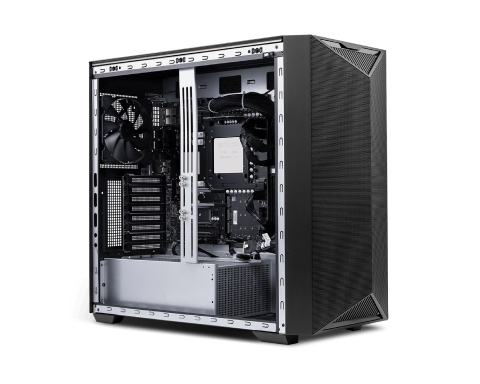
Exxact Valence 4x Max-Q Workstation, NVIDIA DGX Spark, and Exxact Valence built on NVIDIA DGX Station GB300 deliver data‑center‑class AI performance to run bleeding-edge models and agentic AI locally. Your entire AI usage and data in your control.
Get a Quote TodayAgentic AI systems rarely run a single model. A typical pipeline pairs a large reasoning model that plans and delegates with smaller models that retrieve documents, call tools, write code, and check results, and every one of them competes for GPU memory at the same time.
A single Exxact Valence built on NVIDIA DGX Station B300 handles a lot of that from a desk. But what can you do with two?
Each unit is built around the NVIDIA GB300 Grace Blackwell Ultra Desktop Superchip, pairing one Blackwell Ultra GPU with a 72-core Grace CPU over NVLink-C2C. Per NVIDIA's development guide, a single system provides:
What we measured: One Valence with GB300 ran 256 concurrent Qwen3 agents with zero failed agents and a stable 0.824–0.897 pass-rate range. With DeepSeek V4 Flash, vLLM reported 11.1 million tokens of KV-cache capacity—enough for an estimated 10.6 simultaneous sessions configured for one million tokens each.
Those results reinforce the practical limit: agent count alone is not the bottleneck. Model architecture, context length, and KV-cache demand determine capacity. Weights that spill beyond the 252GB of HBM3e into LPDDR5X also run at much lower bandwidth, so repeated agent calls amplify the slowdown.
Two GB300 Systems link directly with no switch. NVIDIA's two-system playbook calls for two 400G QSFP cables match port 0s and port 1s on each Exxact Valence with GB300. Each cable acts as an independent 400Gb/s rail running RoCEv2 (RDMA over Converged Ethernet) which moves data between systems' memory with minimal CPU involvement.
There is no NVLink between the two systems. NVIDIA estimates 45 to 60 minutes for core fabric bring-up, including jumbo frames (MTU 9000) and a GPUDirect RDMA check before running NCCL, Ray, or vLLM.
A few practical details to plan for:
Two units give you two GPUs, 504GB of HBM3e, 1,496GB of total coherent memory across two separate pools, and up to 40 petaFLOPS of sparse FP4. How you spend that depends on which of four deployment patterns fits your workload.
| Pattern | What runs where | Load on the 800Gb/s link | Redundancy |
|---|---|---|---|
| Split roles | Orchestrator on unit A, tool and execution models on unit B | Light (prompts and responses) | Partial |
| Shard one large model | One model split across both GPUs | Heavy (activations every token) | None |
| High availability | Identical stack mirrored on both | Minimal | Full |
| Parallel long-context sessions | Sessions routed to either unit | Minimal | Full |
Unit A dedicates its 252GB of HBM3e to the orchestrator model and its KV cache—the stored attention state that grows with context. Unit B runs the execution tier, with tool models isolated in separate MIG partitions when appropriate. Plans and results move between the systems as lightweight text traffic.
The two systems provide 504GB of aggregate HBM3e. For example, a 550-billion-parameter model at 4-bit precision requires roughly 275GB for weights alone. NVIDIA's dual-system vLLM workflow targets this type of deployment with the 550B-parameter Nemotron 3 Ultra mixture-of-experts model.
Mirror the complete agent stack on both systems and place a load balancer in front. An active-active configuration distributes normal traffic across both nodes, while active-standby keeps one system ready as a warm spare.
Sessions are routed to either system instead of sharing one GPU. This distributes the growing KV-cache demand created by retrieved documents, tool results, and accumulated context.
| Spec | 1x Exxact Valence with B300 | 2x Exxact Valence with B300 | HGX B300 server |
|---|---|---|---|
| GPUs | 1 Blackwell Ultra | 2 Blackwell Ultra | 8 Blackwell Ultra (B300 SXM) |
| GPU memory (HBM3e) | 252GB | 504GB | 2,304GB |
| Total coherent memory | 748GB | 1,496GB (two pools) | HBM plus host memory, config-dependent |
| Aggregate HBM bandwidth | 7.1TB/s | 14.2TB/s | Up to 64TB/s |
| FP4 AI compute | Up to 20 PFLOPS (sparse) | Up to 40 PFLOPS (sparse) | Up to 144 PFLOPS |
| GPU-to-GPU link | N/A | 2x 400Gb/s RoCEv2 (~100GB/s) | NVLink 5 at 1.8TB/s per GPU |
| Scale-out | Pairs with one peer | Documented maximum | 8x ConnectX-8 at 800Gb/s per GPU, switched fabric |
| Deployment | Deskside, 1,600W PSU | Two deskside units, two circuits | Rack server (8U air or 4U liquid cooled) |
| When to Choose | • Your largest model plus its KV cache fits in 252GB of HBM3e • One team is developing and testing agents with low concurrent users • Occasional downtime is acceptable | • Need more than 252GB of fast memory or more than 748GB total • Need redundancy • Rack space and data center power/cooling not an option • Want a separate but dedicated inference, fine tuning. | • Need tensor-parallel serving of trillion-parameter models at production throughput • Dozens or hundreds of concurrent users • Workload is multi-node fine-tuning and/or training • You expect to grow past two nodes into a switched cluster |
Two linked units extend what a desk can do, but they remain two separate computers joined by Ethernet. The limits show up in four places:
No. Two QSFP cables connect the units directly, one per 400Gb/s rail.
NVIDIA documents clustering two systems and doesn't publish a configuration beyond that. Teams that need more nodes should look at rack-scale HGX infrastructure.
No. They operate as two nodes over RoCEv2, and frameworks such as vLLM with Ray, or NCCL-based training, handle distributing work between them.
NVIDIA rates it for models up to 1 trillion parameters within the 748GB coherent pool. Anything beyond the 252GB of HBM3e runs from slower LPDDR5X, so expect lower tokens per second than a model that fits entirely in GPU memory.
Split roles. It keeps every model in fast local memory, puts almost no load on the link, and still leaves the option to reconfigure for sharding or high availability later.
Two linked units make the most sense when an agent system has outgrown one GPU's fast memory but doesn't justify a rack. Size your orchestrator model and KV cache against 252GB of HBM3e first. If it fits, the second unit is best spent on tool models or redundancy. If it doesn't, sharding across the pair buys headroom at the cost of per-token speed, and a workload that needs more than that is the signal to plan for an HGX B300 deployment.
Scaling Agentic AI at the Desk with Exxact Valence
The Exxact Valence with GB300 is available at Exxact for teams running agentic AI locally and can configure a matched pair with the cabling needed for a two-node setup. For workloads that have outgrown deskside hardware, Exxact also builds HGX B300 servers and full rack deployments.
Exxact Valence 4x Max-Q Workstation, NVIDIA DGX Spark, and Exxact Valence built on NVIDIA DGX Station GB300 deliver data‑center‑class AI performance to run bleeding-edge models and agentic AI locally. Your entire AI usage and data in your control.
Get a Quote Today