Storage
What is EDSFF? - E1.S & E1.L, E3.S & E3.L
December 29, 2025
12 min read

Modern data centers demand storage solutions that deliver maximum performance and density. While traditional hard drives and SATA SSDs have served their purpose, NVMe SSDs with their high-speed PCIe interfaces have become the gold standard for enterprises requiring the fastest storage infrastructure.
The Enterprise and Data Center SSD Form Factor (EDSFF) is a growing NVMe SSD form factor purpose-built to maximize performance, power efficiency, thermal management, and storage density in enterprise settings over traditional 2.5” U.2 and M.2 NVMe SSDs.
EDSFF drives offer
In this guide, we'll explore the EDSFF family—including E1.S, E1.L, E3.S, and E3.L—and examine how these form factors are transforming data center storage architecture.
EDSFF (Enterprise and Data Center SSD Form Factor) emerged as a solution to overcome the constraints of legacy SSD designs, prioritizing airflow, density, serviceability, and performance. By doing so, EDSFF enables organizations to achieve superior space utilization and power efficiency in high-density storage deployments.
EDSFF is often found in conjunction with compute servers to keep fast data close, minimizing latency. Also, there are dedicated EDSFF storage platforms.
EDSFF introduces an entirely new connector design that natively supports hot-swappable operation while delivering form factors specifically optimized for storage server density:
Multiple thickness options are available to accommodate varying heatsink requirements, for supporting higher power draw to push more performance.
Before EDSFF, enterprise storage relied on two primary NVMe form factors, each with distinct limitations:
M.2 NVMe Drives
2.5-Inch U.2 Drives
The E1.S and E1.L form factors represent EDSFF's compact, high-density storage solutions optimized for space-constrained environments, prioritizing airflow thermals while maximizing density per rack unit.
E1.S delivers a hot-swappable, gum-stick profile designed to fit perfectly within 1U servers. E1.L extends this design philosophy with a ruler-style format that can accommodate up to 60TB of storage, making it ideal for capacity-intensive workloads.
| Form Factor | Capacity Ranges | Thickness | Length | TDP |
| E1.S 9.5mm | 800GB - 8TB | 9.5mm | 118.75mm | 20W |
| E1.S 15mm | 800GB - 8TB | 15mm | 118.75mm | 25W |
| E1.S 25mm | 800GB - 8TB | 25mm | 118.75mm | 25W |
| E1.L 9.5mm | Up to 60TB | 9.5mm | 318.75mm | 25W |
| E1.L 18mm | Up to 60TB | 18mm | 318.75mm | 40W |
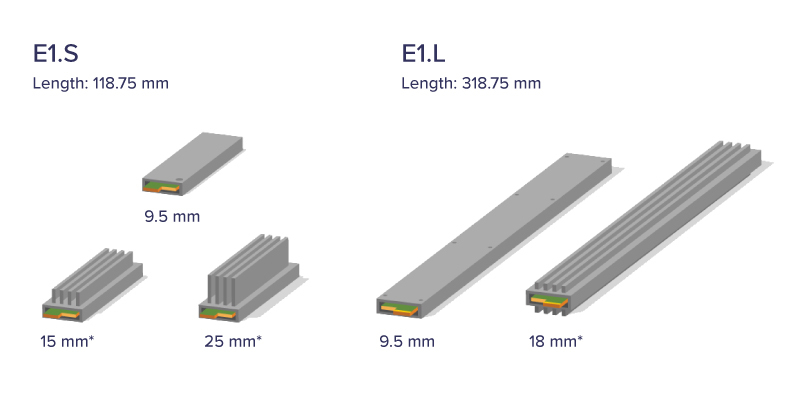
The E1.S form factor represents the most compact member of the EDSFF family, serving as a hot-swappable successor to the M.2 form factor for data center environments. Front-mounted and precisely sized to match the width of a 1U chassis, E1.S drives are engineered for high-density, low-power deployments where storage must be tightly packed.
The E1.L form factor extends the E1.S design to deliver substantially higher capacity per drive. This longer profile accommodates additional NAND flash chips, making it the preferred choice for capacity-intensive applications. In storage-dedicated 1U servers, E1.L drives can dramatically amplify the density of high-speed NVMe storage within a single rack unit.
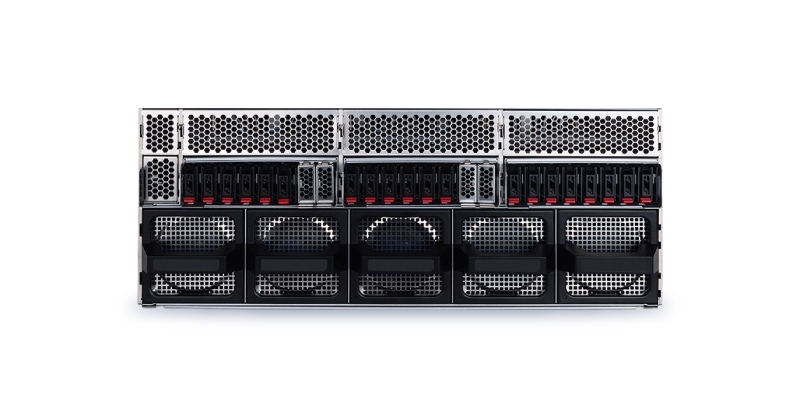
Exxact TensorEX NVIDIA MGX 4U Server features 20x E1.S Hot-swap Drive Bays coupled in an NVIDIA MGX platform. Fast and dense storage close to the compute enables hyper-fast throughput with minimal latency, power AI workloads, simulation models, and more with confidence. Configure Exxact TensorEX TS4-109509664 today.
The E3.S and E3.L form factors represent EDSFF's high-performance storage solutions engineered for demanding enterprise workloads, delivering superior power delivery and thermal management in the familiar 2.5-inch chassis profile.
E3.S provides a hot-swappable, high-performance alternative to legacy 2.5-inch U.2 drives, perfectly sized for 2U servers. E3.L extends this performance-oriented design with additional length to accommodate higher capacity and increased power delivery up to 70W, making it the ultimate choice for workloads requiring both maximum performance and substantial storage capacity.
| Form Factor | Thickness | Width | Length | TDP |
| E3.S | 7.5mm | 76mm | 112.75mm | 25W |
| E3.S 2T | 16.8mm | 76mm | 112.75mm | 40W |
| E3.L | 7.5mm | 76mm | 142.2mm | 40W |
| E3.L 2T | 16.8mm | 76mm | 142.2mm | 70W |
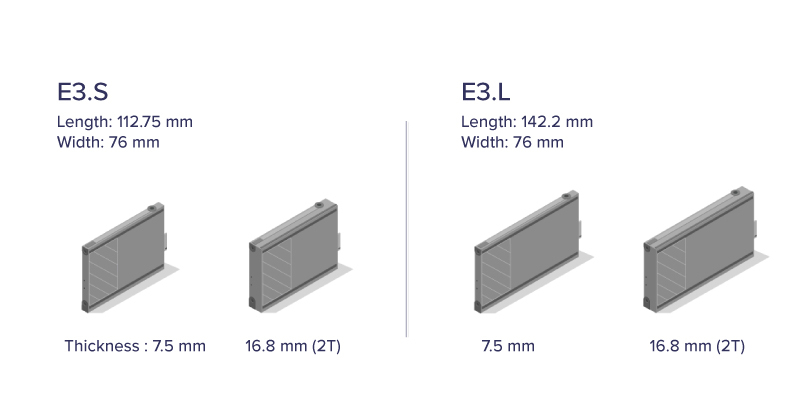
The E3.S form factor offers a high-performance alternative to conventional 2.5-inch drives, specifically engineered for demanding workloads that require superior airflow and thermal management. While physically similar to 2.5-inch SATA or U.2 drives, E3.S leverages the EDSFF interface to enable higher power consumption and significantly enhanced performance capabilities. The 2.5-inch profile aligns perfectly with the internal height specifications of a 2U server chassis.
The E3.L form factor merges the performance characteristics and thermal advantages of E3.S with significantly expanded capacity. Slightly longer than its E3.S counterpart, E3.L can house additional NaND flash chips, for even higher-capacity storage potential. The extended design also supports increased power delivery, translating to even better performance characteristics.
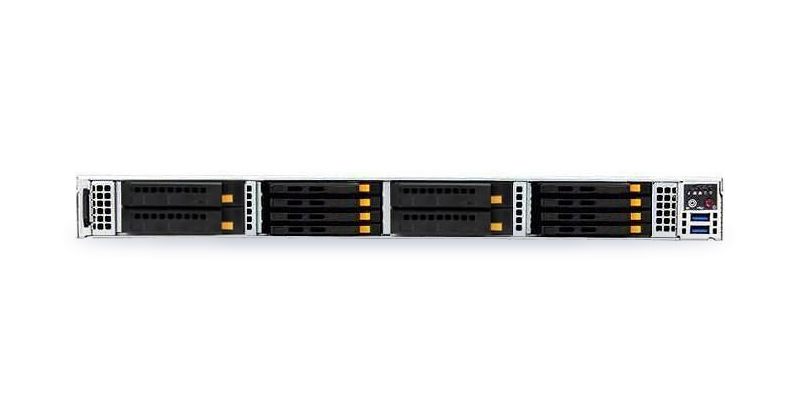
Exxact TensorEX 1U Storage Server features the 12x E3.S Storage Server dedicated for fast data storage in a slim 1U form factor. Equip your data center with dense storage. Get a quote on Exxact TensorEX TTT-123850123 today.
The rapid adoption of EDSFF stems from several compelling advantages that directly address critical data center challenges:
EDSFF's optimized designs—particularly the E1.S and E1.L variants—enable organizations to achieve dramatically higher storage densities. Data centers can now pack substantially more storage capacity into identical or even reduced physical footprints, maximizing the return on expensive rack space.
Every EDSFF form factor is purpose-engineered to promote optimal airflow and thermal dissipation, tackling one of the most significant operational challenges in modern data centers. Additionally, EDSFF drives deliver more efficient power utilization compared to legacy form factors, reducing both energy costs and cooling requirements.
Hot-swap capability is native to all EDSFF drives, allowing technicians to replace failed or upgrade drives without powering down systems. This design choice dramatically reduces maintenance-related downtime and improves overall system availability.
Though EDSFF drives may carry a premium over U.2, the increased density and power efficiency often result in lower total cost of ownership in large deployments. Through optimized physical dimensions, superior thermal management, and unprecedented density, EDSFF drives enable organizations to scale storage infrastructure efficiently while handling increasingly demanding workloads.
The computational requirements of today's most advanced applications—generative AI models, data-intensive HPC simulations like weather forecasting and molecular dynamics, and large language models—demand not only massive computing power but equally massive pools of high-speed storage to feed that compute. Keeping that data local to the compute servers and running a large software-defined storage platform can decrease latency and increase throughput.
Major storage manufacturers, including Samsung, Kioxia, and Micron, now offer EDSFF up to 60TB with 120+TB drives on the horizon. There is broad support from server OEMs, and Exxact is positioned to offer solutions with EDSFF drives.
Ready to leverage the density and performance advantages of EDSFF? Exxact offers EDSFF-enabled storage and compute servers!
Whether you need guidance on high-performance storage architecture or are ready to deploy bulk NVMe storage solutions, our team is here to help. Contact Exxact to discuss your storage requirements, or explore our Enterprise Storage Solutions to configure a system tailored to your infrastructure.
Modern data centers demand storage solutions that deliver maximum performance and density. While traditional hard drives and SATA SSDs have served their purpose, NVMe SSDs with their high-speed PCIe interfaces have become the gold standard for enterprises requiring the fastest storage infrastructure.
The Enterprise and Data Center SSD Form Factor (EDSFF) is a growing NVMe SSD form factor purpose-built to maximize performance, power efficiency, thermal management, and storage density in enterprise settings over traditional 2.5” U.2 and M.2 NVMe SSDs.
EDSFF drives offer
In this guide, we'll explore the EDSFF family—including E1.S, E1.L, E3.S, and E3.L—and examine how these form factors are transforming data center storage architecture.
EDSFF (Enterprise and Data Center SSD Form Factor) emerged as a solution to overcome the constraints of legacy SSD designs, prioritizing airflow, density, serviceability, and performance. By doing so, EDSFF enables organizations to achieve superior space utilization and power efficiency in high-density storage deployments.
EDSFF is often found in conjunction with compute servers to keep fast data close, minimizing latency. Also, there are dedicated EDSFF storage platforms.
EDSFF introduces an entirely new connector design that natively supports hot-swappable operation while delivering form factors specifically optimized for storage server density:
Multiple thickness options are available to accommodate varying heatsink requirements, for supporting higher power draw to push more performance.
Before EDSFF, enterprise storage relied on two primary NVMe form factors, each with distinct limitations:
M.2 NVMe Drives
2.5-Inch U.2 Drives
The E1.S and E1.L form factors represent EDSFF's compact, high-density storage solutions optimized for space-constrained environments, prioritizing airflow thermals while maximizing density per rack unit.
E1.S delivers a hot-swappable, gum-stick profile designed to fit perfectly within 1U servers. E1.L extends this design philosophy with a ruler-style format that can accommodate up to 60TB of storage, making it ideal for capacity-intensive workloads.
| Form Factor | Capacity Ranges | Thickness | Length | TDP |
| E1.S 9.5mm | 800GB - 8TB | 9.5mm | 118.75mm | 20W |
| E1.S 15mm | 800GB - 8TB | 15mm | 118.75mm | 25W |
| E1.S 25mm | 800GB - 8TB | 25mm | 118.75mm | 25W |
| E1.L 9.5mm | Up to 60TB | 9.5mm | 318.75mm | 25W |
| E1.L 18mm | Up to 60TB | 18mm | 318.75mm | 40W |
The E1.S form factor represents the most compact member of the EDSFF family, serving as a hot-swappable successor to the M.2 form factor for data center environments. Front-mounted and precisely sized to match the width of a 1U chassis, E1.S drives are engineered for high-density, low-power deployments where storage must be tightly packed.
The E1.L form factor extends the E1.S design to deliver substantially higher capacity per drive. This longer profile accommodates additional NAND flash chips, making it the preferred choice for capacity-intensive applications. In storage-dedicated 1U servers, E1.L drives can dramatically amplify the density of high-speed NVMe storage within a single rack unit.
Exxact TensorEX NVIDIA MGX 4U Server features 20x E1.S Hot-swap Drive Bays coupled in an NVIDIA MGX platform. Fast and dense storage close to the compute enables hyper-fast throughput with minimal latency, power AI workloads, simulation models, and more with confidence. Configure Exxact TensorEX TS4-109509664 today.
The E3.S and E3.L form factors represent EDSFF's high-performance storage solutions engineered for demanding enterprise workloads, delivering superior power delivery and thermal management in the familiar 2.5-inch chassis profile.
E3.S provides a hot-swappable, high-performance alternative to legacy 2.5-inch U.2 drives, perfectly sized for 2U servers. E3.L extends this performance-oriented design with additional length to accommodate higher capacity and increased power delivery up to 70W, making it the ultimate choice for workloads requiring both maximum performance and substantial storage capacity.
| Form Factor | Thickness | Width | Length | TDP |
| E3.S | 7.5mm | 76mm | 112.75mm | 25W |
| E3.S 2T | 16.8mm | 76mm | 112.75mm | 40W |
| E3.L | 7.5mm | 76mm | 142.2mm | 40W |
| E3.L 2T | 16.8mm | 76mm | 142.2mm | 70W |
The E3.S form factor offers a high-performance alternative to conventional 2.5-inch drives, specifically engineered for demanding workloads that require superior airflow and thermal management. While physically similar to 2.5-inch SATA or U.2 drives, E3.S leverages the EDSFF interface to enable higher power consumption and significantly enhanced performance capabilities. The 2.5-inch profile aligns perfectly with the internal height specifications of a 2U server chassis.
The E3.L form factor merges the performance characteristics and thermal advantages of E3.S with significantly expanded capacity. Slightly longer than its E3.S counterpart, E3.L can house additional NaND flash chips, for even higher-capacity storage potential. The extended design also supports increased power delivery, translating to even better performance characteristics.
Exxact TensorEX 1U Storage Server features the 12x E3.S Storage Server dedicated for fast data storage in a slim 1U form factor. Equip your data center with dense storage. Get a quote on Exxact TensorEX TTT-123850123 today.
The rapid adoption of EDSFF stems from several compelling advantages that directly address critical data center challenges:
EDSFF's optimized designs—particularly the E1.S and E1.L variants—enable organizations to achieve dramatically higher storage densities. Data centers can now pack substantially more storage capacity into identical or even reduced physical footprints, maximizing the return on expensive rack space.
Every EDSFF form factor is purpose-engineered to promote optimal airflow and thermal dissipation, tackling one of the most significant operational challenges in modern data centers. Additionally, EDSFF drives deliver more efficient power utilization compared to legacy form factors, reducing both energy costs and cooling requirements.
Hot-swap capability is native to all EDSFF drives, allowing technicians to replace failed or upgrade drives without powering down systems. This design choice dramatically reduces maintenance-related downtime and improves overall system availability.
Though EDSFF drives may carry a premium over U.2, the increased density and power efficiency often result in lower total cost of ownership in large deployments. Through optimized physical dimensions, superior thermal management, and unprecedented density, EDSFF drives enable organizations to scale storage infrastructure efficiently while handling increasingly demanding workloads.
The computational requirements of today's most advanced applications—generative AI models, data-intensive HPC simulations like weather forecasting and molecular dynamics, and large language models—demand not only massive computing power but equally massive pools of high-speed storage to feed that compute. Keeping that data local to the compute servers and running a large software-defined storage platform can decrease latency and increase throughput.
Major storage manufacturers, including Samsung, Kioxia, and Micron, now offer EDSFF up to 60TB with 120+TB drives on the horizon. There is broad support from server OEMs, and Exxact is positioned to offer solutions with EDSFF drives.
Ready to leverage the density and performance advantages of EDSFF? Exxact offers EDSFF-enabled storage and compute servers!
Whether you need guidance on high-performance storage architecture or are ready to deploy bulk NVMe storage solutions, our team is here to help. Contact Exxact to discuss your storage requirements, or explore our Enterprise Storage Solutions to configure a system tailored to your infrastructure.

.jpg?format=webp)
.jpg?format=webp)