Scientific Computing

New Amber26 + AmberTools26 Release

May 5, 2026
6 min read

EXX-Blog-Amber26-Ambertools-Release.jpg

AMBER for Molecular Dynamics Overview

AMBER for Molecular Dynamics just released their Amber26 and AmberTools26 on April 30th 2026 with a couple of new and improved features.

AMBER is a long-standing molecular dynamics (MD) software suite used to simulate biomolecules such as proteins, nucleic acids, and protein-ligand systems. It is common in academic and industry research groups working in drug discovery, structural biology, and materials-adjacent biomolecular modeling.

From a computing standpoint, AMBER workloads typically benefit from modern NVIDIA GPUs, fast storage, and enough CPU and memory to keep the GPUs fed. That makes platform selection and environment setup an important part of a smooth upgrade.

Amber26 New Release Overview

Amber26 brings updates across advanced methods, system building, and implicit solvent tooling.

  • If you run alchemical free energy or other advanced workflows, plan for a short validation cycle after upgrading.
  • If you share environments across a team, prioritize repeatable installs, version pinning, and a small regression suite.
  • For GPU nodes, confirm driver and CUDA compatibility before rolling the upgrade out broadly.

Below is the official changelog content from AMBERMD, included as-is:

Improvements to Advanced Methods

  • Enhancements to alchemical transformation pathways/softcore potentials and alchemical enhanced sampling (ACES) method:
  • advanced lambda scheduling options including new tools for optimized phase space overlap lambda-spacing
  • scaffold-hopping and absolute binding free energy capability through lambda-dependent "Boresch" bond, angle, and torsion restraints
  • lambda-dependent RMSD-fitting restraints to floating reference molecular scaffolds
  • non-equilibrium work framework (Jarzynski and Crooks equations) for alchemical free energy transformations and end-state (e.g., MM->QM or MM->ML) book-ending simulations
  • advanced methods for network-wide alchemical free energy analysis of protein-ligand binding thermodynamic graphs with cycle closure and experimental constraints.
  • Improved REMD structure reservoir options, including reservoirs for H-REMD and flexible reservoir temperature with T-REMD
  • Gaussian accelerated MD (LIG-GaMD).

New System Building Capabilities

  • Lignin Force Field
  • Better LEaP support for large systems, with extended pdb-formats and faster parametrization times
  • Antechamber - GAFF2 update MMcif support
  • Compute RESP charge using QUICK via antechamber
  • ProPrep: A new interactive workflow manager, called ProPrep, for preparing AMBER MD and QM/MM simulations of (metallo)proteins.

Improved Implicit Solvent Methods

  • New tensor-based Poisson-Boltzmann solver backend in PBSA, with GPU acceleration, preconditioning, and matrix-free operation.
  • Bundled LibTorch now ships in two versions (2.5.1 and 2.10.0), expanding CUDA support from 11.8 through 13.0.
  • Implicit solvent/explicit ion solvent model (GBION). The parameters have been refined to handle DNA and protein-DNA complexes, most importantly the nucleosome.
  • Added highly-accurate dSASA method for calculating the solvent accessible surface area in nonpolar solvation free energy calculations, as well as forces required for MD simulations.

AmberTools26 Release Overview

AmberTools26 is where many day-to-day preparation and analysis utilities live. In practice, these updates matter because they sit on the critical path for building systems, parameterizing molecules, and running post-processing across many projects.

  • Installation and environment consistency, especially if you use conda-based workflows across multiple machines.
  • Prep utilities and file format support, which can reduce friction when dealing with large systems or modern structure formats.
  • Analysis tool updates, which can affect reproducibility if scripts rely on specific output formats.

Most teams will see the biggest day-to-day impact from workflow updates, not from a single headline performance number. The practical goal is a clean upgrade that keeps results consistent and avoids environment issues across users and nodes.

Below is the official changelog content from AMBERMD, included as-is.

Among the new features (more coming soon)

  • Improved conda package for binary installation
  • New proprep package to guide users through system preparation tasks
  • packmol-memgen-gui: graphical interface for packmol-memgen
  • Better support for pdb-format files that describe large systems
  • Compute RESP charge using QUICK via antechamber
  • Added dSASA method for calculating the solvent accessible surface area in nonpolar solvation free energy calculations, as well as forces required for MD simulations
  • Bundled LibTorch now ships in two versions (2.5.1 and 2.10.0), expanding CUDA support from 11.8 through 13.0
  • New tensor-based Poisson-Boltzmann solver backend in PBSA, with GPU acceleration, preconditioning, and matrix-free operation
  • New and updated forcefields:
    • RNA force fields with updated hydrogen-bonding parameters
    • New developments for the polarized Gaussian model (pGM) for electrostatic interactions
  • cpptraj updates: (See also a Detailed changelog for cpptraj.)
  • build, a CPPTRAJ based tool to create prmtop files.

Expectations for Amber26

  • New capabilities for advanced methods can change how you set up specific protocols, especially free energy and enhanced sampling.
  • GPU performance should remain predictable, assuming similar settings and a stable driver stack. GPUs are still highly impactful and while fast data storage to keep GPUs fed is equally important
  • Shared environments need a rollout plan, test the install, run a small regression suite, then expand access.

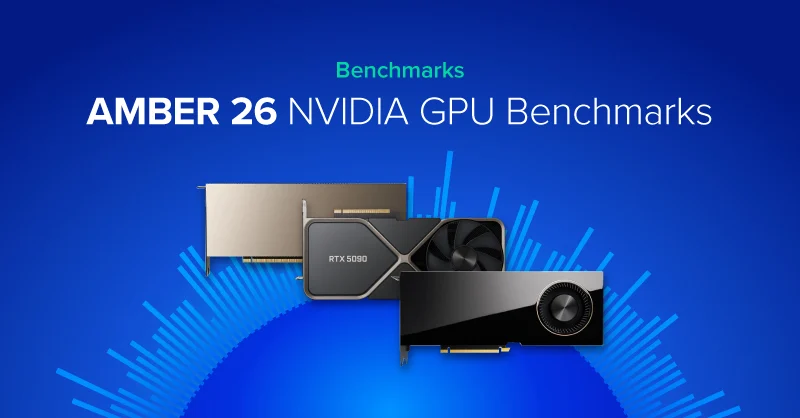
You can view AMBER Benchmarks on our supported software page or read our AMBER benchmark blog, which we performed with an industry expert. The numbers were run on a previous version, but our AMBER expert noted that between versions, the performance gain isn’t highly drastic. These numbers serve as a

You can download and run AmberTools26 for free upon request on their website. Amber26 requires a license, which is free for EDU/non-profit or paid for commercial/industrial institutions.

At Exxact, we specialize in offering configurable solutions that deliver preloaded and validated with the Life Sciences and Materials Science applications you need. We offer EDU discounts and can help determine the ideal system within your budget. Talk to one of our engineers today.
We're Here to Deliver the Tools to Power Your Research

With access to the highest-performing hardware and industry experts, Exxact offers platforms optimized for your Life Science reseach deployment, budget, and desired performance so you can continue your groundbreaking innovations.

Configure your Protein Folding System Today
EXX-Blog-Amber26-Ambertools-Release.jpg
Scientific Computing

New Amber26 + AmberTools26 Release

May 5, 20266 min read

AMBER for Molecular Dynamics Overview

AMBER for Molecular Dynamics just released their Amber26 and AmberTools26 on April 30th 2026 with a couple of new and improved features.

AMBER is a long-standing molecular dynamics (MD) software suite used to simulate biomolecules such as proteins, nucleic acids, and protein-ligand systems. It is common in academic and industry research groups working in drug discovery, structural biology, and materials-adjacent biomolecular modeling.

From a computing standpoint, AMBER workloads typically benefit from modern NVIDIA GPUs, fast storage, and enough CPU and memory to keep the GPUs fed. That makes platform selection and environment setup an important part of a smooth upgrade.

Amber26 New Release Overview

Amber26 brings updates across advanced methods, system building, and implicit solvent tooling.

  • If you run alchemical free energy or other advanced workflows, plan for a short validation cycle after upgrading.
  • If you share environments across a team, prioritize repeatable installs, version pinning, and a small regression suite.
  • For GPU nodes, confirm driver and CUDA compatibility before rolling the upgrade out broadly.

Below is the official changelog content from AMBERMD, included as-is:

Improvements to Advanced Methods

  • Enhancements to alchemical transformation pathways/softcore potentials and alchemical enhanced sampling (ACES) method:
  • advanced lambda scheduling options including new tools for optimized phase space overlap lambda-spacing
  • scaffold-hopping and absolute binding free energy capability through lambda-dependent "Boresch" bond, angle, and torsion restraints
  • lambda-dependent RMSD-fitting restraints to floating reference molecular scaffolds
  • non-equilibrium work framework (Jarzynski and Crooks equations) for alchemical free energy transformations and end-state (e.g., MM->QM or MM->ML) book-ending simulations
  • advanced methods for network-wide alchemical free energy analysis of protein-ligand binding thermodynamic graphs with cycle closure and experimental constraints.
  • Improved REMD structure reservoir options, including reservoirs for H-REMD and flexible reservoir temperature with T-REMD
  • Gaussian accelerated MD (LIG-GaMD).

New System Building Capabilities

  • Lignin Force Field
  • Better LEaP support for large systems, with extended pdb-formats and faster parametrization times
  • Antechamber - GAFF2 update MMcif support
  • Compute RESP charge using QUICK via antechamber
  • ProPrep: A new interactive workflow manager, called ProPrep, for preparing AMBER MD and QM/MM simulations of (metallo)proteins.

Improved Implicit Solvent Methods

  • New tensor-based Poisson-Boltzmann solver backend in PBSA, with GPU acceleration, preconditioning, and matrix-free operation.
  • Bundled LibTorch now ships in two versions (2.5.1 and 2.10.0), expanding CUDA support from 11.8 through 13.0.
  • Implicit solvent/explicit ion solvent model (GBION). The parameters have been refined to handle DNA and protein-DNA complexes, most importantly the nucleosome.
  • Added highly-accurate dSASA method for calculating the solvent accessible surface area in nonpolar solvation free energy calculations, as well as forces required for MD simulations.

AmberTools26 Release Overview

AmberTools26 is where many day-to-day preparation and analysis utilities live. In practice, these updates matter because they sit on the critical path for building systems, parameterizing molecules, and running post-processing across many projects.

  • Installation and environment consistency, especially if you use conda-based workflows across multiple machines.
  • Prep utilities and file format support, which can reduce friction when dealing with large systems or modern structure formats.
  • Analysis tool updates, which can affect reproducibility if scripts rely on specific output formats.

Most teams will see the biggest day-to-day impact from workflow updates, not from a single headline performance number. The practical goal is a clean upgrade that keeps results consistent and avoids environment issues across users and nodes.

Below is the official changelog content from AMBERMD, included as-is.

Among the new features (more coming soon)

  • Improved conda package for binary installation
  • New proprep package to guide users through system preparation tasks
  • packmol-memgen-gui: graphical interface for packmol-memgen
  • Better support for pdb-format files that describe large systems
  • Compute RESP charge using QUICK via antechamber
  • Added dSASA method for calculating the solvent accessible surface area in nonpolar solvation free energy calculations, as well as forces required for MD simulations
  • Bundled LibTorch now ships in two versions (2.5.1 and 2.10.0), expanding CUDA support from 11.8 through 13.0
  • New tensor-based Poisson-Boltzmann solver backend in PBSA, with GPU acceleration, preconditioning, and matrix-free operation
  • New and updated forcefields:
    • RNA force fields with updated hydrogen-bonding parameters
    • New developments for the polarized Gaussian model (pGM) for electrostatic interactions
  • cpptraj updates: (See also a Detailed changelog for cpptraj.)
  • build, a CPPTRAJ based tool to create prmtop files.

Expectations for Amber26

  • New capabilities for advanced methods can change how you set up specific protocols, especially free energy and enhanced sampling.
  • GPU performance should remain predictable, assuming similar settings and a stable driver stack. GPUs are still highly impactful and while fast data storage to keep GPUs fed is equally important
  • Shared environments need a rollout plan, test the install, run a small regression suite, then expand access.

You can view AMBER Benchmarks on our supported software page or read our AMBER benchmark blog, which we performed with an industry expert. The numbers were run on a previous version, but our AMBER expert noted that between versions, the performance gain isn’t highly drastic. These numbers serve as a

You can download and run AmberTools26 for free upon request on their website. Amber26 requires a license, which is free for EDU/non-profit or paid for commercial/industrial institutions.

At Exxact, we specialize in offering configurable solutions that deliver preloaded and validated with the Life Sciences and Materials Science applications you need. We offer EDU discounts and can help determine the ideal system within your budget. Talk to one of our engineers today.

We're Here to Deliver the Tools to Power Your Research

With access to the highest-performing hardware and industry experts, Exxact offers platforms optimized for your Life Science reseach deployment, budget, and desired performance so you can continue your groundbreaking innovations.

Configure your Protein Folding System Today